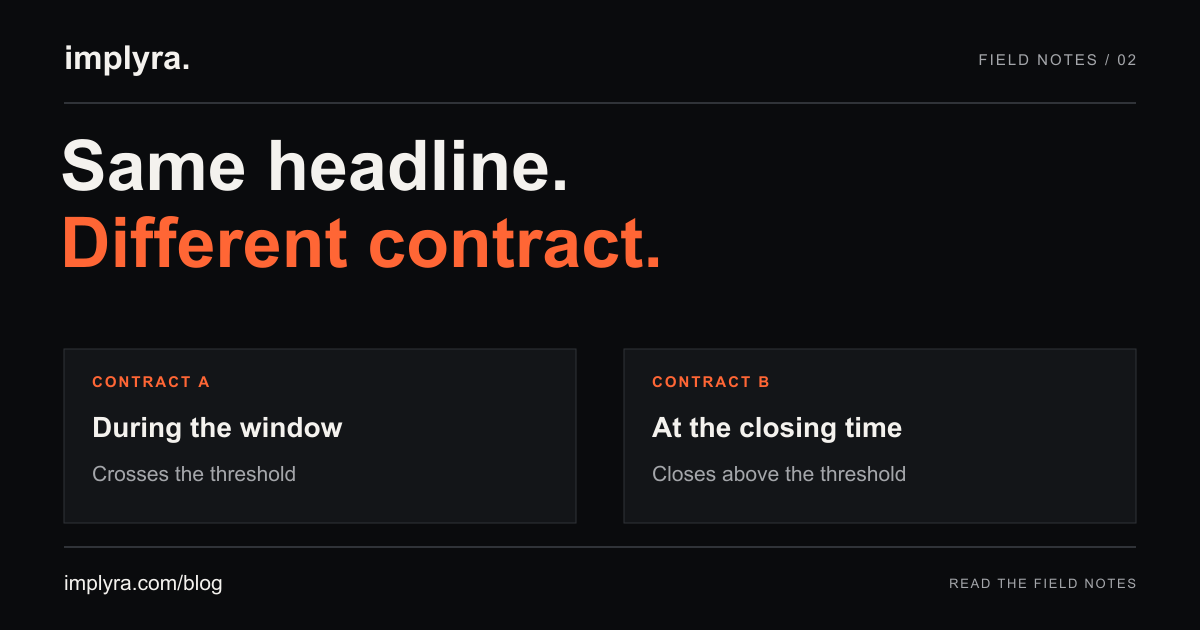
Before comparing the odds, compare the rules
A practical method for matching Polymarket and Kalshi markets: outcomes, thresholds, sources, clocks and the prices you can actually compare.
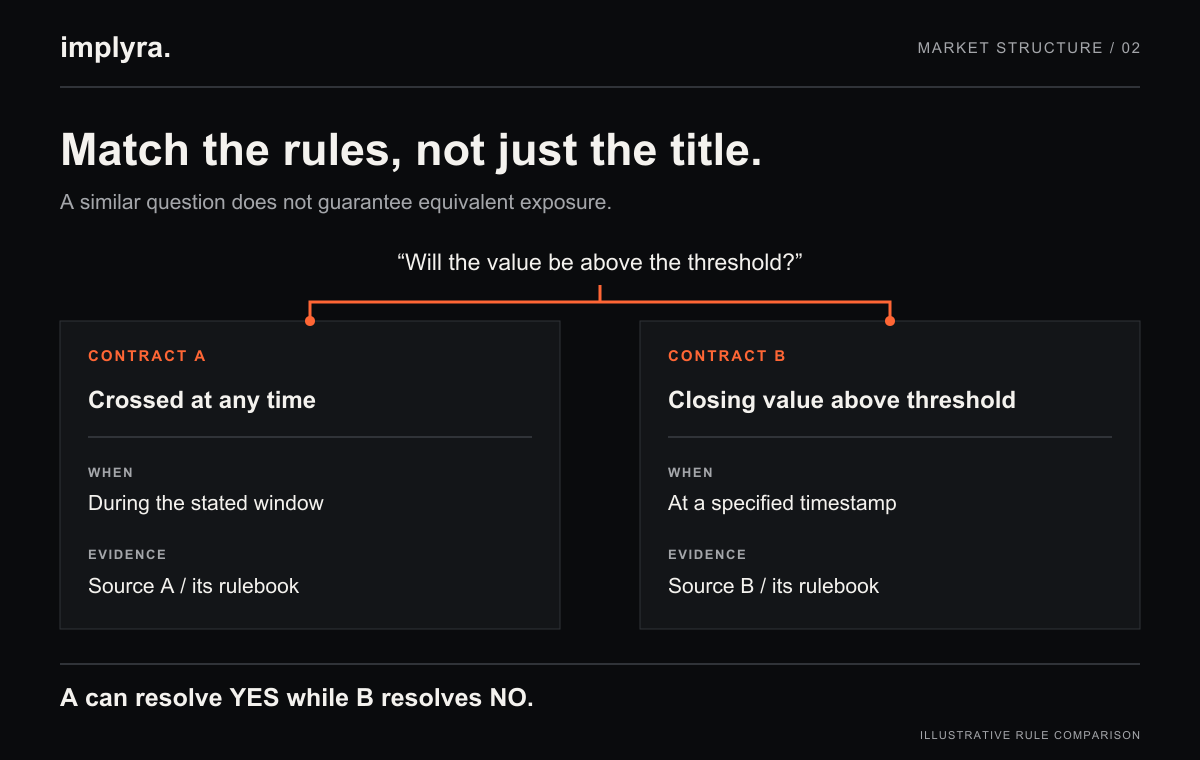
Two markets carry almost the same headline. One displays 60%, the other 66%. Before interpreting the six-point difference, establish whether both contracts pay on the same event. A matching title is a useful search result, but the settlement terms decide what the prices describe.
This guide uses invented contracts and quotes to demonstrate a comparison workflow. They are not current Polymarket or Kalshi listings, and none of the figures below describes an available trading opportunity.
Translate each contract into a precise statement
Polymarket’s resolution documentation identifies the source, end date and edge cases as parts of the rules. Kalshi explains that its rules summary identifies the measured value, timeline and verification source, while the full rules contain additional terms. Open the complete text on both venues.
Write down what must happen, where it must happen, the exact threshold, the observation window and the authoritative source. Then inspect rounding, revisions and exceptional outcomes. “Above 30” excludes exactly 30; “30 or above” includes it. A one-character difference in the predicate can change the payout.
Work through a case where the answers diverge
Imagine two fictional contracts summarized as “Metro City reaches 30°C on June 1.” A uses an airport station and local standard time; B uses a central station and UTC. Their thresholds differ too, as the table below shows. These invented rules are not attributed to either venue.
Suppose the airport records a maximum of 29°C in A’s window, while the central station records 31°C in B’s window. A resolves No and B resolves Yes. Owning A-Yes and B-No would therefore produce two losing positions, even though the combination appears to cover opposite answers to the headline.
For a numerical illustration, assume 100 A-Yes shares cost $60 and 100 B-No shares cost $30. The combined $90 purchase can pay $0 in that scenario. The apparent discount to a $100 payout depended on an equivalence that did not exist.
Station and clock details are practical concerns. Kalshi’s weather documentation distinguishes daily and hourly sources and explains that daily climate reports use local standard time. Always inspect the specific contract instead of importing assumptions from a weather app or a similar market.
| Term | Contract A | Contract B |
|---|---|---|
| Measured event | Daily maximum temperature | Daily maximum temperature |
| Station | Metro Airport | Metro Central |
| Threshold | 30°C or above | Strictly above 30°C |
| Observation window | June 1, local standard time | June 1, UTC |
| Source | Named agency’s final station report | Named agency’s final station report |
| Comparison status | Related subject | Different payout conditions |
Give the comparison an explicit status
A useful research workflow distinguishes three outcomes. “Equivalent” means the reviewed terms describe the same payout event. “Related” means the markets share a topic but differ on a material condition. “Unresolved” means the evidence is insufficient to make the comparison. These are proposed research labels, not official venue classifications.
Check orientation separately. “Will the event occur?” and “Will the event fail to occur?” may be complements after their remaining rules are checked. Comparing both Yes prices directly would reverse the interpretation. Store an explicit mapping from each outcome to a common event statement.
Compare the same kind of price
After reviewing the rules, inspect quote semantics. Polymarket documents its displayed price as a midpoint, with a last-trade fallback for wide spreads. Kalshi’s order book exposes resting quantities and prices. A chart point, midpoint, last trade and available ask are different observations.
Consider a second hypothetical example with genuinely equivalent binary events and ordinary complementary payouts. The displayed Yes prices are 60% and 66%, a six-percentage-point gap. But suppose the available ask for A-Yes is $0.63 and the available ask for B-No is $0.40. Buying one of each costs $1.03 for a combined $1 settlement payout: a $0.03 loss before fees.
Record the side, available size and timestamp for every quote. A price available for ten shares does not describe the cost of a thousand-share purchase. Comparing a fresh quote against an old observation can also create a gap that was never simultaneously available.
Keep the observation and settlement clocks separate
The event’s observation window, trading close, outcome determination and payment time can differ. Kalshi specifically distinguishes market close from determination and notes that official-source confirmation may arrive later. Polymarket documents a proposal and dispute process for resolution. Identical event definitions do not imply simultaneous settlement.
Save the rule text or a dated reference alongside the venue identifiers, outcome mapping and quote timestamp. Recheck material clarifications before reusing an old match. This gives a future reviewer a way to understand the comparison as it existed when the observation was made.
The minimum useful comparison record
A spread becomes informative when the reader can see what it compares. Preserve the contract differences beside the numbers, and let an unresolved match stay unresolved. That makes the comparison useful even when the correct conclusion is simply that the markets describe different events.
- Both venue market identifiers and the exact outcomes being compared.
- Threshold, location, observation window and authoritative source.
- Material exceptions, rounding or revision rules, plus the dated source links.
- Match status, outcome orientation, quote type, size and observation time.
Sources & further reading
Inspect available Polymarket and Kalshi market records, then check each venue’s full settlement rules before comparing prices.
Explore market research